
1. Set the total stake from a fixed spending limit
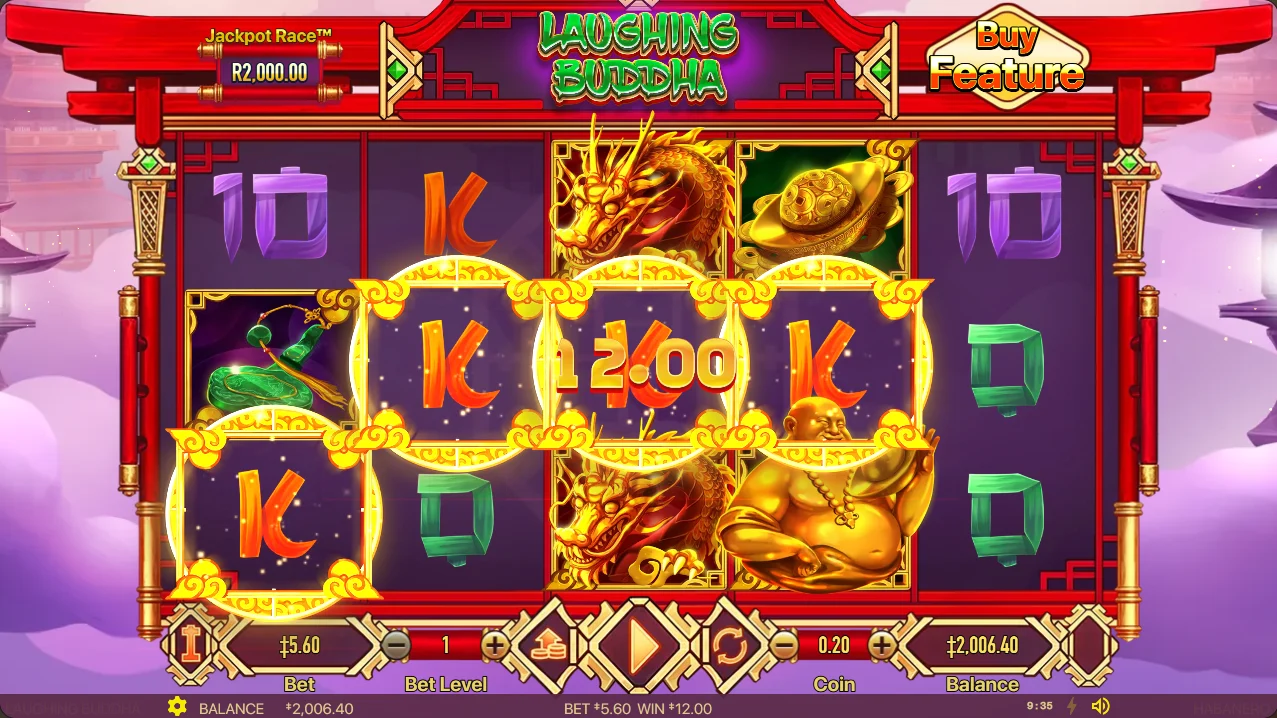
A workable Laughing Buddha strategy starts with a number you can read before the reels move. Choose a total stake, not just a small-looking coin denomination. This game multiplies Coin by Bet Level and by 28 active lines. At the default 0.20 coin and level 1, a spin costs 5.60. A player who budgets as if each click costs 0.20 is underestimating exposure by a factor of 28.
Examples use one consistent currency or demo unit. If coin value is R0.10, totals are rand; this does not convert the demo’s fun credits into rand. Limits in your actual game still apply.
For an illustrative R200 budget, a R2.80 spin allows 71 consecutive losing spins before less than one stake remains. At R5.60, the same budget allows 35. Neither figure predicts the duration of a real session: payouts can extend it, and a feature purchase can shorten it sharply. It is a conservative cost comparison that assumes zero returns and no stake changes.
Keep everyday expenses outside that limit. A casino balance is not a target to recover by increasing stakes, and a larger deposit does not improve the game’s theoretical return. If the chosen total stake makes an ordinary losing sequence uncomfortable, lower it before play rather than negotiate a higher limit after the losses arrive. The free demo can be used to learn the controls without risking cash.
A fixed stake also makes a session easier to understand. You can compare returned amounts as multiples of the same cost and check how the balance changes. If you deliberately change the stake, note where it changed. Otherwise a larger cash win at a larger cost can look like a better system when it simply represents more money exposed to the same rules.
A low stake is useful because it reduces the amount lost on a non-paying round. It is not a special mathematical setting that makes the reels more generous. Likewise, increasing a bet after a win can increase the size of the next payout in cash, but it also increases the next loss. Compare returns as multiples of the actual stake before deciding that one stake size produced a better result.
2. Track net profit rather than the win animation
Net profit is the returned amount minus the actual cost. In our first recorded base spin, a 5.60 stake returned 12.00. That is +6.40 net. A later 1.00 return from the same stake was −4.60 net, despite being a non-zero payout. A win animation tells you that credits were returned; it does not tell you that the round increased the balance.
Swipe sideways to see every column →
| Return from a 5.60 spin | Net result | Meaning |
|---|---|---|
| 0.00 | −5.60 | No returned stake |
| 1.00 | −4.60 | Partial return |
| 5.60 | 0.00 | Break-even round |
| 12.00 | +6.40 | Profitable round |
Across our ten base spins, five returned some credits and only one returned more than the stake. Total cost was 56.00, total return was 18.00 and the net result was −38.00. Saying “five winning spins out of ten” without defining a win would hide that distinction. Use “payout” for any return and “profit” for a positive net result.
The same rule applies to a purchased bonus. Its result must exceed the whole feature price before the purchase becomes profitable. Subtracting only its normal base stake produces the wrong answer. Our 182-unit purchase returned 12.32, so the net was −169.68. The final screen’s large “You have won” message did not change that arithmetic.
3. Choose stopping rules before the first spin
A stop-loss or take-profit rule can limit a session’s length and exposure. It cannot change the paytable or the probability of the next result. Define the rule in net balance terms. For example, an illustrative player starting with R200 might stop if the balance reaches R160 or R220. Those thresholds are budgeting examples, not settings demonstrated to make this slot profitable.

In hindsight, stopping after our first spin would have preserved +6.40. That is a true statement about these ten observations, but it is not a discovered advantage. We already know the first result was positive. A rule invented after seeing the path needs a new, independently collected sample before it can be judged as a test. Even then, a profitable finite sample would not prove a positive long-run expectation.
A practical stop needs an action attached to it. Stop autoplay, let any already-paid feature finish and record the final balance. If a spin crosses a threshold, the outcome may overshoot it. A R40 stop-loss is not a guarantee that the final loss cannot exceed R40 when individual stakes are large. The threshold is checked at actual completed rounds, not at every frame of a reel animation.
Starting again immediately with the same stake after hitting a stop-loss is a new session label, not a reset of the money already lost. A limit only controls total spending if you include those restarts in the overall budget. If you intend to restart, decide the maximum number of sessions and combined exposure in advance rather than treating each restart as a fresh opportunity to recover.
If you compare fixed-session and stop-limit approaches, count the spins each one actually places. A rule that stops after one profitable spin has much less exposure than a rule that continues for ten. Comparing only their final profits hides that difference. Record the number of paid starts and total cost beside any replay result, especially when the stopping thresholds were selected using the same history.
4. Compare a bonus purchase with ordinary-spin exposure
A Buy Feature click costs approximately 46.43 normal stakes in this version. It buys eight initial free games with a symbol choice; it does not buy 46 ordinary spins. This makes it a concentrated transaction. The fact that it reaches the feature immediately does not make it lower-risk for a small balance.
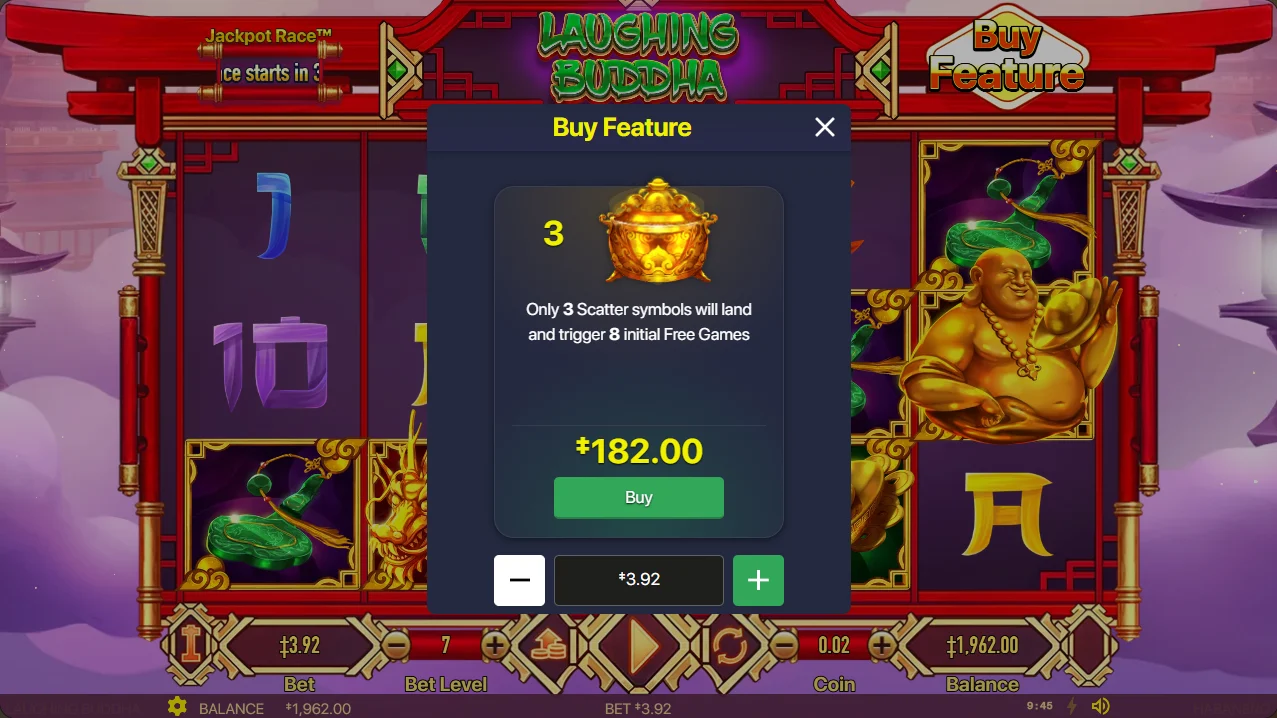
At a 3.92 normal stake, the purchase price is 182.00. On a hypothetical 200-unit balance, that single debit uses 91% of the starting funds before any return. At a 2.80 normal stake, the arithmetic purchase price is 130.00, or 65% of that balance. Whether those choices are available depends on the actual client limits. These percentages describe exposure, not the chance of a loss.
Our selected configuration stated 96.64% RTP for normal play and 96.57% for the purchase. The 0.07-percentage-point difference is small compared with the uncertainty of one bonus outcome. It should not distract from the immediate spending decision: can the balance absorb the full purchase cost? The current operator’s version may state different figures, so compare within one actual launch.
The free demo is a useful place to inspect the purchase panel. Read its complete price, the number of initial games and any disabled-button message. Our first 260-unit choice exceeded a 210-unit cap. One ordinary decrease changed the stake to 3.92 and the feature price to 182. We describe that flow so you can recognise a limit without treating the error message as a request to increase your stake.
5. Treat the symbol pick as a feature choice, not a predictor
Three pots reveal three possible expanding symbols. Our options were J, Buddha and K. We chose Buddha. Its ordinary five-symbol line award is larger than those of J or K, but the award table does not reveal how often each option will land in useful positions. A higher possible payout is not, by itself, a higher expected profit.
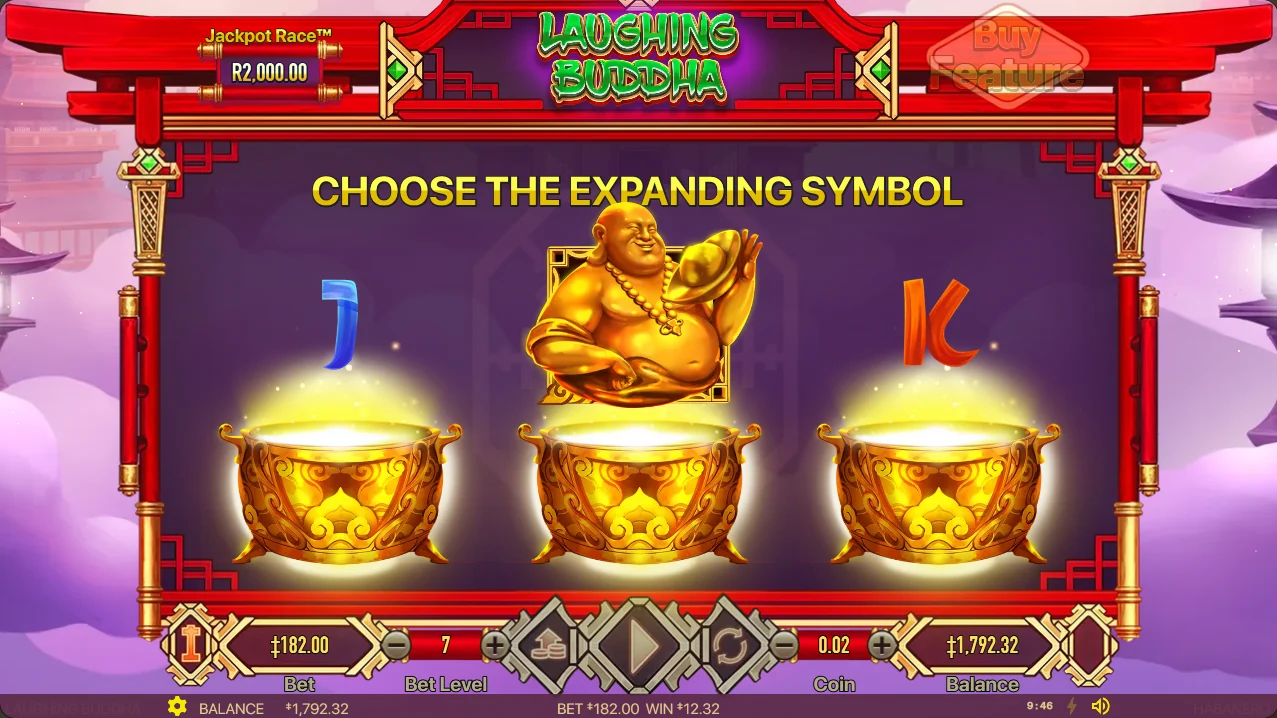
The chosen symbol expands where the feature rules allow, leaving Wild and Scatter positions intact. A large visual block of Buddhas may still fail to connect a paying left-to-right combination. It is possible to see expansion and receive no payout from that free game. Evaluate the credited result, not only the number of large symbols filling the screen.
We found no instruction in this client assigning a superior RTP to a named choice. Its Help says player strategy cannot affect theoretical RTP unless otherwise stated. There is consequently no supported “always pick the middle pot” or “always pick the most expensive symbol” rule on this page. We can describe the controls accurately without inventing an optimal choice.
A fair comparison would need predeclared selection rules and fresh observations under the same configuration. It would retain low-return features and record retriggers, not just the best screenshot for each symbol. Our purchased feature finished all eight free games without a retrigger or additional free-game payout. That is one complete case, not a ranking of the three symbols.
6. Do not raise stakes because a bonus looks overdue
Two Scatters, a slow final reel or several non-paying spins can feel like a signal. They are not a verified forecast of the next result. The game does not publish a rule that an ordinary loss sequence guarantees a bonus after a fixed number of attempts. Waiting for a certain animation or changing the timing of a tap has not been demonstrated to improve the RTP in this client.
Doubling after losses changes the cost of the next bet. It does not repair the previous outcomes. Starting at a hypothetical 2.80 stake, a doubling sequence would request 2.80, 5.60, 11.20, 22.40, 44.80 and 89.60. Those six bets total 176.40 before a seventh is attempted. Exact stake combinations and limits may prevent that sequence from being available at all.
Slot payouts also make simple Martingale claims particularly misleading. A non-zero payout can still be below the stake, and a later winning line need not cover earlier losses. The game does not offer an even-money coin toss where every win returns a fixed two times the stake. A large escalation can therefore coincide with a small partial return and still leave the session substantially down.
A fixed percentage of balance can reduce exposure as funds fall, but the available stake steps make it approximate. A 1% target on 200 units is 2 units; this client may not offer exactly that total with the displayed combinations. Rounding upward defeats the intended cap. If you use percentage budgeting, choose a permitted stake at or below the target and stop when none fits.
Quick Spin and autoplay should be evaluated as pace controls. Faster play can place more total stakes in the same time, even if each stake is unchanged. If your goal is to keep spending visible, slower manual play makes the final balance easier to check. Neither pace should be advertised as a mathematical advantage.
7. Keep a short record that can actually answer a question
- Write down the game version or the two RTP figures shown in Help.
- Record the starting balance, normal stake and any separate feature price.
- Count paid starts separately from free-game continuations.
- Wait for each paid round to finish; keep a pending feature marked incomplete.
- Add costs and returned amounts, then calculate the net result.
- Compare any proposed rule on new observations rather than only the history that suggested it.
A record should also state what the money represents. Our observations use fun-play units. A South African rand example in the calculator is an illustration of the same stake formula, not a real-money result. A cash withdrawal would require a different kind of evidence involving the operator account and payment process; none was tested here.
Small samples can still teach useful things when their purpose is narrow. Our ten base spins establish a working result flow and show the difference between payout frequency and profit. The purchased feature establishes how the cost, pick and eight child games fit together. Neither sample is large enough to choose a reliable profit-making system or estimate the frequency of rare outcomes.
A promising rule needs a precise instruction that another person could follow without seeing the future. “Raise the stake before a good spin” is not testable; it assumes the answer. “Keep a 2.80 stake and stop after a completed round takes the balance below a predeclared limit” is testable, although it does not create an advantage. Precision makes a comparison honest even when the result is unexciting.
Quick answers
Can you win money on Laughing Buddha?
Individual paid rounds can return more than their cost. Our first demo spin did. That does not mean a session or strategy will be profitable, and demo credits have no cash value.
What is the best setting for a small budget?
Choose a total stake that fits the budget after multiplying coin, level and all 28 lines. There is no verified stake setting that changes this client’s theoretical return.
Should I raise the stake after two Scatters?
We found no rule making that a predictive signal. Raising the stake increases the amount exposed on the next paid spin.
Does a stop-loss create a winning strategy?
It can restrict exposure when followed, but it does not change the game’s payout probabilities. Repeated restarts must be included in the same overall spending limit.