
Which Laughing Buddha RTP are you actually playing?
Laughing Buddha does not have one percentage that safely describes every launch. The provider advertises approximate RTP options around 86%, 92%, 94%, 97% and 98%. The client we opened on 4 November 2026 selected configuration 665. Its rendered Help screen stated 96.64% for normal play and 96.57% for the three-Scatter Buy Feature option.
The table below comes from the mappings in that delivered game build. Only the 665 configuration was played in our session. The other rows show selectable variants present in the client code, not five separately measured experiments. An operator may use a different permitted configuration, so the Help screen in the actual game remains the relevant check.
Swipe sideways to see every column →
| Configuration in client | Normal play | Three-Scatter purchase | Evidence |
|---|---|---|---|
| 662 | 86.61% | 86.45% | Code mapping; not played |
| 663 | 92.22% | 92.14% | Code mapping; not played |
| 664 | 93.98% | 94.01% | Code mapping; not played |
| 665 | 96.64% | 96.57% | Selected demo and rendered Help |
| 666 | 97.98% | 98.06% | Code mapping; not played |
At 96.64%, the theoretical difference from 100% is 3.36 percentage points. Applied to R1,000 of cumulative qualifying stakes, that corresponds to R33.60 in expected loss under the stated mathematical model. Cumulative stakes are not the same as a deposit: repeatedly wagering returned money increases turnover. A R100 balance can therefore produce more than R100 of total stakes during a session.
This calculation is an expectation across many possible outcomes, not a forecast that a R1,000 session will finish at R966.40. A short session can end above its starting balance or lose much more. High volatility describes an uneven pattern of returns. It does not replace the RTP percentage and it does not specify how soon a bonus or large win will occur.
The percentage for a purchased feature is a return relative to the purchase cost, not the associated normal-spin stake. At the observed 182-unit price and 96.57% theoretical return, the model’s expected difference is about 6.24 units per such purchase when averaged over the required outcome distribution. One actual purchase can depart enormously from that average. Our 169.68-unit loss is a single realised outcome, not the expected loss for every purchase.
The highest code-mapped purchase RTP is not always attached to the highest normal-play value by the same difference. Configuration 664 maps to 93.98% normal and 94.01% purchase, for example. It would therefore be wrong to apply our 0.07-percentage-point gap to every version. Compare the pair printed for the selected configuration instead of assuming one universal feature penalty.
The version check belongs before a comparison of staking approaches. If two people play different configurations, a difference in observed return cannot be assigned only to their chosen stakes or stop rules. Record the RTP pair, entry route and sample size together. If the version is unavailable, leave it unknown rather than fill in the most attractive number found on another page. That makes a later comparison less ambiguous, even though it still cannot prove future profitability.
Separate line maths, whole-round return and net profit
The ordinary stake has three parts: 28 fixed lines, a coin denomination and a bet level. Multiply them to get the total paid stake. Ordinary symbol awards in the paytable use the line stake. Scatter awards use the total stake. The game then adds qualifying wins across lines, applies the appropriate Wild multipliers and credits the resulting payout.

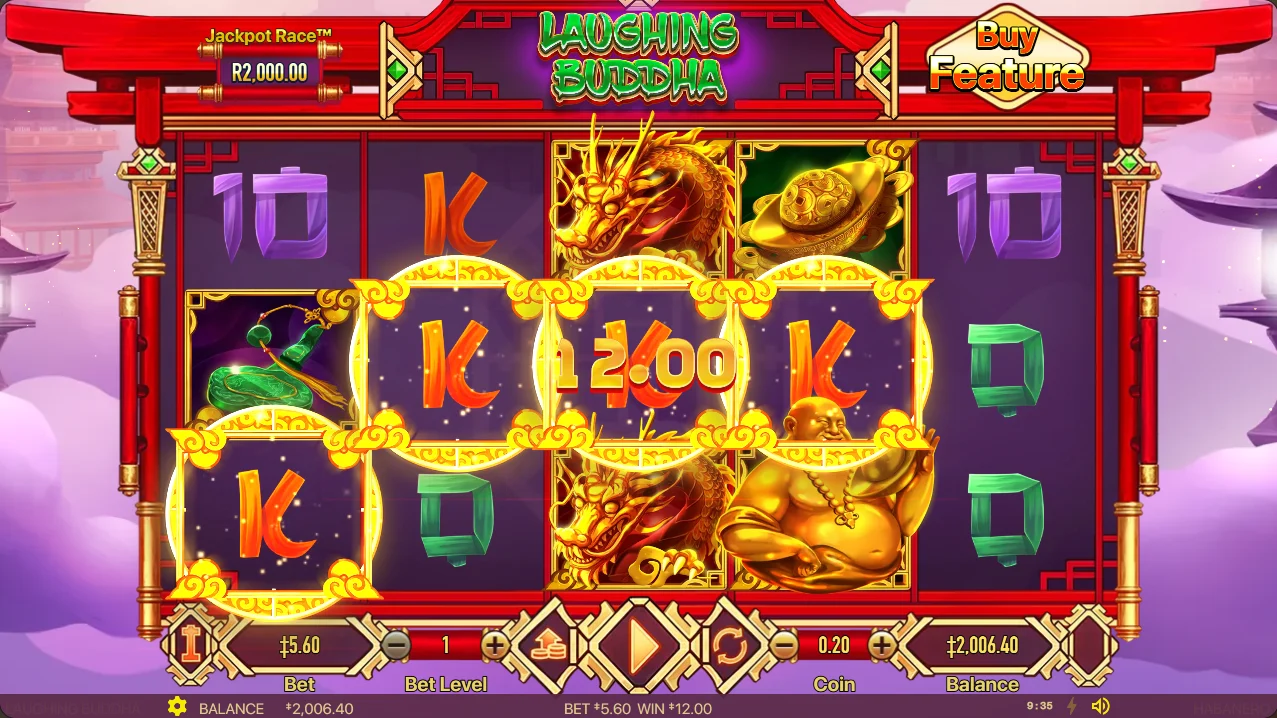
Our first recorded spin returned 12.00 from four K symbols on one paying path. With a line stake of 0.20 and a four-K award of 60 line bets, the payout is 60 × 0.20. The resulting balance was 2,006.40 from a 2,000.00 start. The response contained the paying positions as well as the awarded cash amount, allowing the example to be checked against the visible reels.
A bought feature requires one more distinction. Its 182.00 cost in our example was 1,300 line bets at 0.14 each. The underlying normal stake was 3.92. The trigger and eight free games belonged to that one purchased round. Adding a fictitious 3.92 debit for each free spin would understate the return; ignoring the 182 purchase would overstate profit.
The provider currently lists a maximum multiplier of 2,002×. That is a published game specification, not a result from our small sample. It is also different from the 1,000-line-bet award shown for five Buddhas on one line. A full-round limit, a single-symbol paytable award and a balance delta describe different quantities. We have not independently reproduced a maximum outcome.
What happens between Spin and the final balance?
The browser first loads the game artwork, interface code, language text and a demo session. An initial server response supplies the starting balance and relevant settings. Pressing Spin sends the selected coin denomination, bet level and line count through the normal HTTPS game endpoint. The response supplies a result that the browser then animates.

In this session, game actions used HTTPS requests to a path named /pf. We observed no WebSocket frames. That statement describes the recorded session only; it does not prove that every integration or provider title uses the same transport. A spinning reel is a visual presentation, so animation duration and the time required to receive the server result can be very different.
Swipe sideways to see every column →
| Observed response field | What it established here |
|---|---|
| displaybalance | Balance supplied in the response, checked against the cost and return |
| wincash | Return credited by the current action |
| totalwincash | Accumulated return for the complete paid round so far |
| isgamedone | Whether the paid round was complete |
| nextgamestate | Whether the next phase was main play, symbol selection or free games |
| linewins and winningwindows | Cash awards and reel positions used by the paying lines |
| currentfreegame and numfreegames | Progress within the feature continuation |
The raw session also contains identifiers used to associate actions with the game. They are kept out of public examples. The field names above are descriptive observations, not a guide to making your own requests. The useful point for a player is that one visible bonus can involve several exchanges, while still being only one paid event. Counting responses as spins would inflate a study’s sample size.
The returned reel data records the result after the action. It is not advance knowledge of the next spin. The client’s asset files describe interfaces and rules, but their existence does not reveal a future result or provide a predictor. We did not activate hidden tools, alter server messages or try to force outcomes.
The response also included the visible reel symbols, nearby virtual-reel entries and individual winning positions. Those fields describe a completed action’s result. Nearby entries in an animation window do not prove what the next spin will contain. We did not treat them as a reel-strip probability model or a source of advance predictions. A delivered client can contain presentation data without exposing enough information to reconstruct the server’s random outcome process.
What our complete observation did and did not establish
We recorded ten ordinary spins at a fixed 5.60 total stake, then one separate 182-unit feature purchase. Every completed paid round and each feature continuation reconciled with the server balance. The base sample cost 56.00 and returned 18.00. The purchased round returned 12.32, including its trigger; its eight free games added no further return.
Swipe sideways to see every column →
| Observation | Base spins | Purchased feature |
|---|---|---|
| Paid rounds | 10 | 1 |
| Total cost | 56.00 | 182.00 |
| Total returned | 18.00 | 12.32 |
| Net result | −38.00 | −169.68 |
| Feature continuation | No natural trigger observed | 1 choice and 8 free games |
| Reconciliation | 10 of 10 passed | Complete chain passed |
The observed return ratio for the ten base spins is approximately 32.14%. That is not an estimate strong enough to replace the stated 96.64% RTP. Ten spins are a control and accounting inspection, not a long-run mathematics test. The provider’s Help text says its RTP calculation uses two sets of 500 million game cycles. Our sample serves a different purpose and should not be presented with the same statistical weight.
We did not collect a natural bonus trigger, a retrigger, a maximum win or a real-money payout. The purchased feature confirms that the visible pick and eight-game sequence can finish without another paid debit. It does not validate natural-feature frequency. No counterfactual sample exists for the two symbols we did not choose, and no profitable future strategy follows from the first spin being positive.
For an expanded test, the first additional task would be to complete a naturally triggered feature and verify its accounting. Any later comparison should keep the RTP configuration, stake and entry route explicit. A larger count without those details can be less informative than this small, fully reconciled example. Unfinished features must remain outside completed-round statistics until they settle.
Measured response time is not the same as game speed
Across the ten base-spin requests, the median elapsed time was 134.5 milliseconds and the nearest-rank 95th percentile was 307.9 milliseconds. Timing began when the browser emitted each request and ended after the response body was captured. It therefore includes network travel, server processing and local scheduling. It is not a pure network ping or a measured one-way delay.
These measurements came from the research computer’s connection. They are not a South African mobile-network benchmark, and selecting an en-ZA browser locale does not move that computer into South Africa. The small sample is useful for describing this launch, not for promising that all users will see the same performance. A busy connection, device or operator integration can change the experience.
The first load also fetched interface code, image assets, sounds and several font resources. A repeat visit may reuse cached files, while a clean launch has more to download. That is why the embedded demo on this site starts after you press its load button. Reading the guide should not force a full third-party game download, and opening the demo should remain an explicit action.
Quick Spin shortens the presentation offered by the game. It does not change the selected RTP or make a server request inherently predictive. Similarly, clicking again during a win counter may skip presentation rather than begin a new paid spin. Check the actual balance and settled history instead of estimating the number of bets from the number of taps.
We also inspected the running client at a 390 × 844 viewport. It scaled into a portrait container with smaller controls and substantial vertical artwork. That was a viewport check on the research browser, not a physical Android or iPhone compatibility test. The demo page provides a larger viewing option and a direct official launch if the embedded controls feel too small.
With only ten timing samples, the reported nearest-rank 95th percentile is the largest observation in that group. It is not a stable estimate of the slowest 5% across a full day. The median is less influenced by that single slow request, but it still describes this short session. The initial session request took much longer than an ordinary spin and is intentionally excluded from the ten-spin timing summary.
The displayed jackpot is a separate system
The demo displayed a Jackpot Race panel with a R2,000 amount. Its Help screen described a 120-minute race, two finishing positions paying R1,200 and R800, and a minimum qualifying bet of 2 demo-equivalent units. Those details describe the schedule visible in this launch. They are not a permanent promise for every South African account or future race.
Most importantly, the same Help screen says jackpots cannot be won during Fun Play or Bonus Play. Our session explicitly identified itself as fun play. A jackpot amount appearing above the reels therefore did not make our demo balance eligible for that real-money award. This is a useful example of why an on-screen promotion and the rules for participating in it must be read together.
We did not receive a jackpot award or verify a cash withdrawal. The supplied server and RNG version hashes identify the reported build; they are not a player-verifiable cryptographic proof of each outcome. This client did not present a seed-reveal verification workflow in the inspected controls. We therefore do not label it a provably-fair game on the strength of hashes alone.
The race display can use a currency label different from the fun-credit symbol shown in the balance. The rendered rules explain that jackpot amounts may be displayed in another currency. That is another reason not to label every visible R amount as evidence of a rand wallet or an eligible real-money prize. Our technical findings keep the game balance, theoretical returns and promotional race display separate.
Quick answers
Is the RTP always 96.64%?
No. That was the normal-play value in our selected demo configuration. The provider offers other variants; read Help in the actual game.
Does this slot send wins through WebSockets?
No WebSocket frames were observed in this session. The recorded game actions used HTTPS request/response exchanges.
Can I win the displayed Jackpot Race in the free demo?
The observed Help screen explicitly excludes Fun Play and Bonus Play from jackpot wins.
Can the server result arrive before the animation finishes?
Yes. Our captured result could already contain the final payout while the interface was still counting it up. Wait for the settled amount before recording a win.