
Find the five controls that matter
Laughing Buddha is Habanero’s five-reel slot with three visible positions on each reel and 28 fixed paylines. The opening screen packs several numbers into a small space. Start with Bet, Coin, Bet Level and Balance, then locate the triangular Spin button. Those four numbers tell you what a click will cost and what remains afterwards. The gold pots, pearls and Buddha symbols explain the result only after the reels stop.
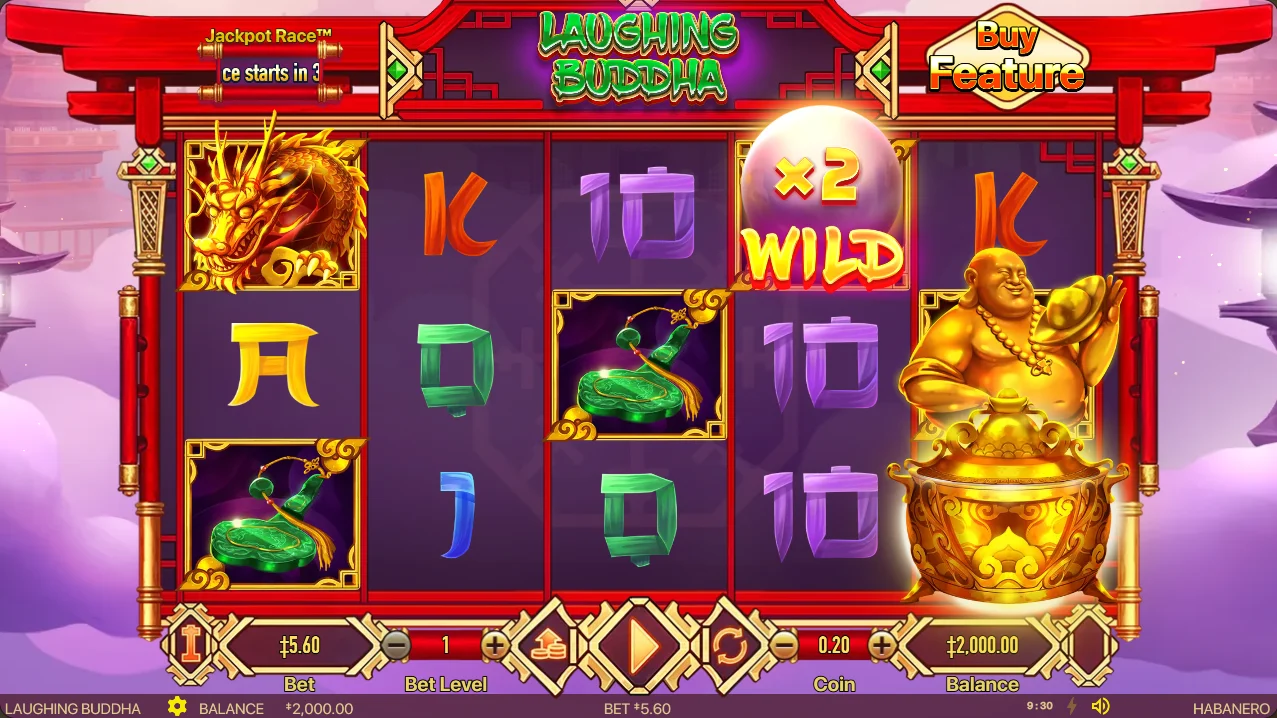
- Open the game and check that its title is Laughing Buddha and the provider is Habanero. A similarly named app, statue shop or game is not this client.
- Read the currency or fun-play label. Our demo starts with 2,000 virtual units; those units cannot be withdrawn.
- Choose Coin and Bet Level. Read the resulting total Bet again before pressing Spin.
- Press Spin once. Wait for the result and any win presentation to finish before judging the new balance.
- Use the information button for the paytable. Use the settings menu and Help for stake limits, RTP and disconnection rules.
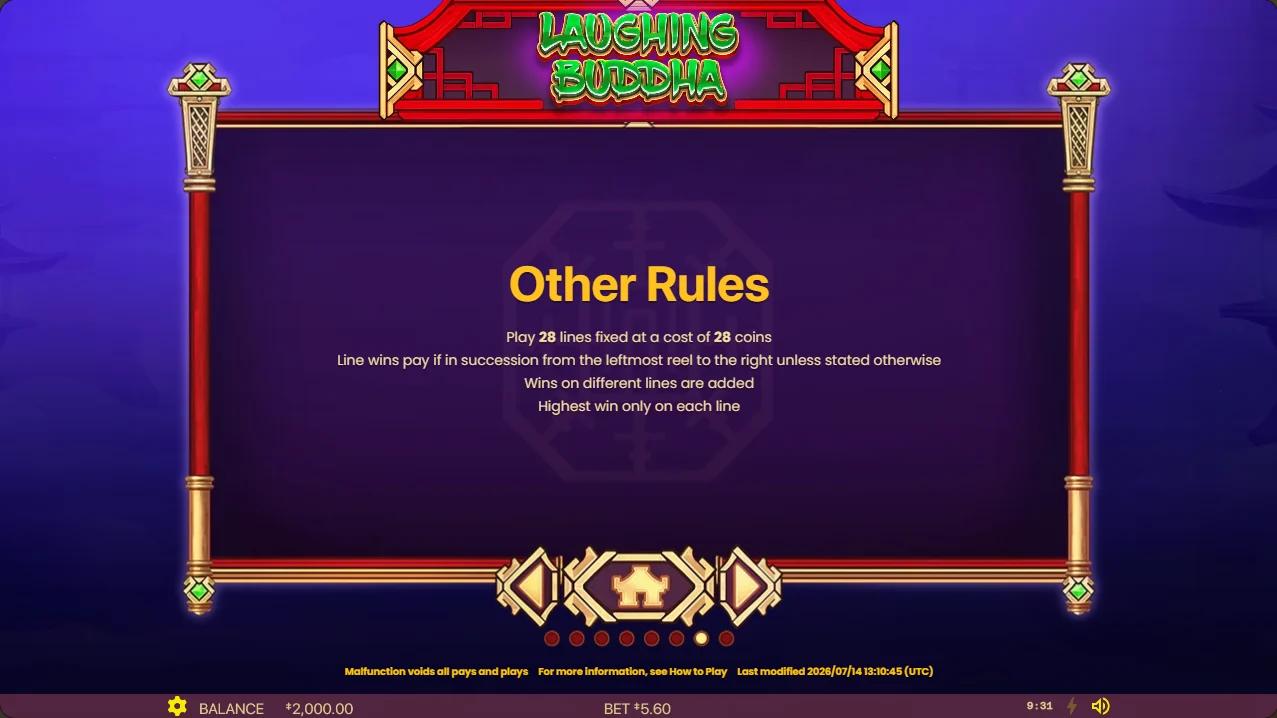
All 28 lines stay active. There is no useful trick in trying to switch off expensive lines: this version does not offer that control. Lower the coin denomination or bet level instead. When comparing screenshots, use the total stake in the message bar. The help text also describes a coins display, which can make the same stake look much larger if you mistake coins for currency.
The circular control beside Spin opens autoplay options in this client. Autoplay is a convenience, not a different payout mode. The Help screen lists a spin count, a balance-decrease stop and a single-win stop. Check the actual settings before starting a sequence. A single-win threshold refers to one returned amount; it is not automatically a target for the net result of the whole session.
Two controls deserve special care on a small screen. The Bet Level plus sits close to Spin, while Coin has its own separate plus and minus. Read the number after a tap rather than relying on the button’s position. If a device rotation rearranges the interface, locate the labels again. Do not assume that a remembered desktop coordinate is still the same action in portrait mode.
The bottom message bar provides another check on the current stake and balance. In our feature purchase, the cost temporarily displayed as 182.00 while the underlying Coin and Bet Level stayed at 0.02 and 7. That was the purchase cost, not a new 182-unit ordinary spin. Read the active mode alongside the number, especially when returning from a bonus panel.
Calculate a spin before you press it
The total stake equals 28 lines multiplied by the coin denomination and the bet level. With Coin at 0.20 and Bet Level at 1, a spin costs 5.60. It does not cost 0.20. With Coin at 0.02 and Bet Level at 7, the line stake is 0.14 and the total is 3.92. Different pairs of controls can produce different totals, so a one-step change is not always a simple doubling.
Examples use one consistent currency or demo unit. If coin value is R0.10, totals are rand; this does not convert the demo’s fun credits into rand. Limits in your actual game still apply.
Swipe sideways to see every column →
| Coin | Level | One line | Total spin |
|---|---|---|---|
| 0.01 | 1 | 0.01 | 0.28 |
| 0.02 | 7 | 0.14 | 3.92 |
| 0.10 | 1 | 0.10 | 2.80 |
| 0.20 | 1 | 0.20 | 5.60 |
| 0.50 | 2 | 1.00 | 28.00 |
The observed Help screen lists coin values from 0.01 to 5 and levels 1, 2, 5, 7 and 10. Its mathematical range is 0.28 to 1,400 total units. That is the range printed in this demo’s help, not a promise that a South African operator will accept every combination. A launch can impose tighter transaction or feature-purchase limits. We encountered a separate 210-unit cap in the Buy Feature panel.
For a rand example, suppose a game actually labels the coin denomination R0.10. Level 1 then costs R2.80 across all 28 lines. A R200 budget covers 71 completely losing spins at that stake, with R1.20 left. That calculation is a spending limit, not a forecast of how many spins you will receive. Payouts, stake changes and a feature purchase all change the balance. The calculator deliberately keeps these assumptions visible.
Do not use the minimum advertised coin value as a headline stake when budgeting. The total price is the decision that matters. This becomes more important with Buy Feature, where the price uses 1,300 line bets. At the same R0.10 line stake, a feature would cost R130 if that exact option and denomination were available. That is a separate transaction from a R2.80 ordinary spin.
Read a winning line from left to right
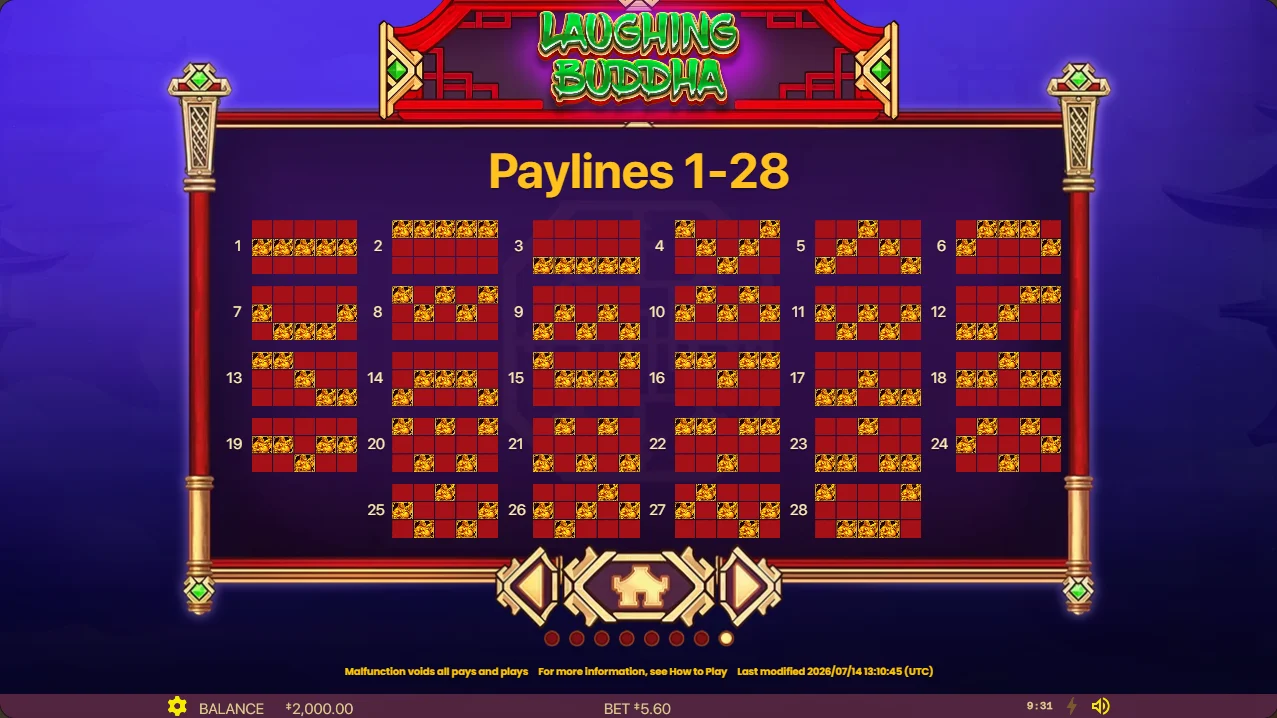
A line win begins on the leftmost reel and follows one of the 28 prescribed paths. Matching symbols on reels 2, 3 and 4 do not automatically pay if reel 1 breaks the combination. The path can rise, fall or zigzag; it does not have to stay in a straight horizontal row. Wins on different lines are added, while only the highest eligible win is paid on each individual line.
In our first recorded base spin, four K symbols paid 12.00 at a total stake of 5.60. The line stake was 0.20 and the four-K award was 60 line bets: 60 × 0.20 = 12.00. The round’s net result was therefore +6.40. The server identified one winning path, with the first K on the bottom position of reel 1 and the next three in the middle positions. The fifth reel did not extend the combination.
This example also shows why the screen’s win counter is not a separate prize. During its animation, the displayed amount was still rising towards 12.00 while the network result already contained the final payout. Read the final counter or history entry. Do not take a screenshot halfway through the count-up and treat that partial number as the completed return.

Scatters are the main exception to ordinary line matching. The gold pots pay anywhere in their permitted reels rather than along a single payline. They appear on reels 1, 3 and 5. Three pots pay one total stake and trigger the free-game feature. Two pots may create an anticipation animation but do not meet the three-pot trigger. A prolonged reel animation is not evidence that a bonus is due.
To inspect a payline yourself, start with the first highlighted position in the paytable diagram. Move one reel to the right at a time and follow the highlighted row. Stop when a symbol no longer matches and no eligible Wild substitutes for it. Then compare the matching length with the symbol’s three-, four- or five-symbol award. Repeat only for the other prescribed paths; do not invent a diagonal that is absent from the 28-line list.
A matching group can contribute to more than one prescribed line if the geometry allows it. That does not mean every repeated symbol on the screen pays independently. The response for our first spin listed one line award of 12.00. In the purchased trigger, four line awards of 2.10 each were added, plus the 3.92 Scatter award. The total was 8.40 + 3.92 = 12.32. This second example shows why the round total need not match any one paytable cell.
Use the paytable without confusing line and total stakes
The in-game paytable displays money amounts for the selected stake. Change the stake and its displayed awards change too. The table below expresses the same awards as multiples of one line stake, so the relationship remains readable. It lists three, four and five matching symbols. It does not give the probability of landing those combinations.
Swipe sideways to see every column →
| Symbol | 3 on a line | 4 on a line | 5 on a line |
|---|---|---|---|
| Buddha / ordinary Wild | 50× | 250× | 1,000× |
| Dragon | 30× | 200× | 500× |
| Gold ingot | 15× | 125× | 400× |
| Jade pendant | 15× | 100× | 300× |
| A | 10× | 75× | 250× |
| K | 10× | 60× | 160× |
| Q | 5× | 40× | 90× |
| J | 5× | 30× | 60× |
| 10 | 5× | 15× | 30× |
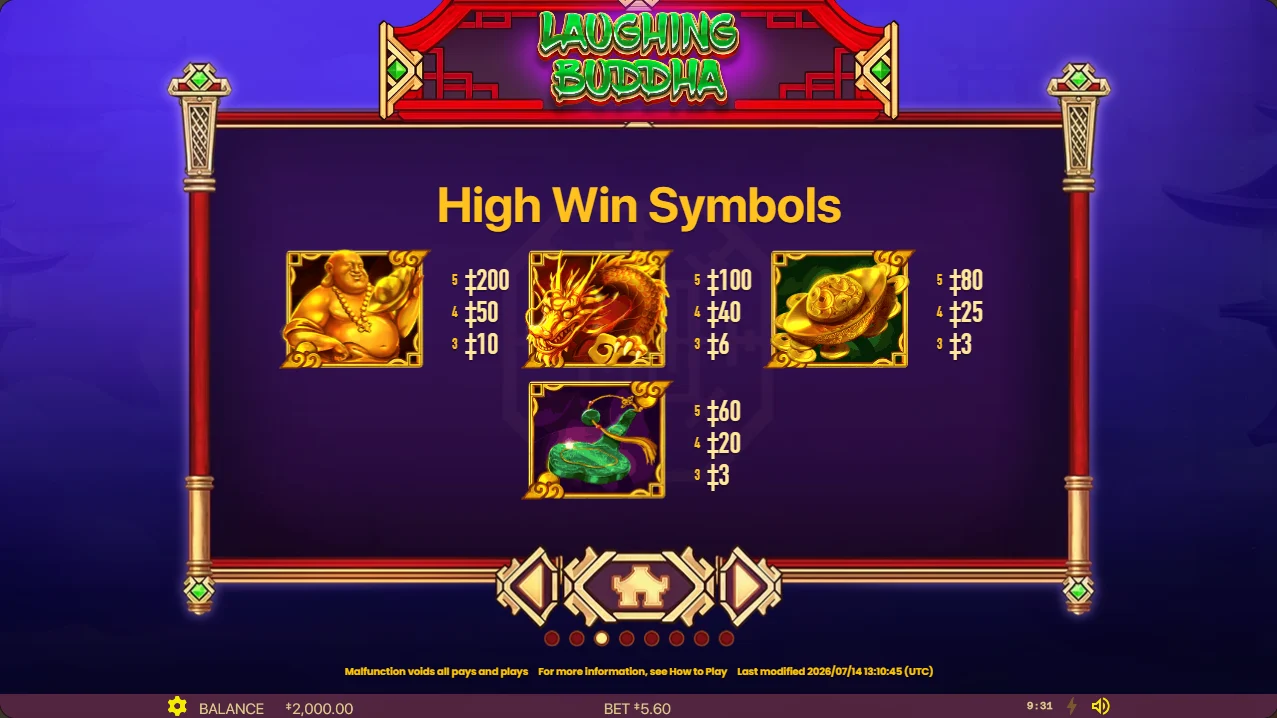
For five Buddhas on one line at a 0.20 line stake, the ordinary award is 200. Relative to the 5.60 total stake, that is about 35.71 times the spin price. Multiple paying lines and eligible wild multipliers can change a round’s total. This conversion is essential when reading a “1,000×” number in a paytable: first establish which stake the multiplier uses.
A higher-paying symbol is not necessarily a more profitable choice in the free games. The paytable gives amounts, not the frequency of each symbol on the feature reels. You would need the full relevant probabilities and rules to compare expected values. Choosing Buddha because its five-symbol award is large is a preference; calling it an independently proven optimal strategy would go beyond the evidence.
The letter symbols still matter. Our first profitable spin came from K symbols, while several small returns later came from low symbols. A small win may slow a falling balance without reversing it. For example, a 1.00 payout from a 5.60 spin returns part of the stake but leaves a net loss of 4.60. Use the final balance rather than the brightness of the win animation to assess the result.
When the paytable shows five Wilds paying the same base amount as five Buddhas, keep that ordinary symbol award separate from the pearl multiplier rule. The multiplier applies to an eligible winning combination according to the rules; it is not an extra payment for simply seeing a pearl anywhere on the screen. A pearl outside the positions used by a particular paying line does not automatically multiply that line.
For an easy manual check, use a round with a single ordinary line and no feature. The four-K example is suitable because its arithmetic needs only the line stake and the four-symbol award. A round containing several Wilds, multiple paying paths and Scatters can also be checked, but each component must be separated first. Trying to read the complete total straight from the biggest symbol on screen skips that accounting.
Understand pearls, multipliers and the bonus choice
The pearl Wild substitutes for normal symbols but not for the gold-pot Scatter. It reveals a 2× or 3× multiplier at random. When a multiplier Wild participates in a winning combination, that line’s win uses the highest applicable multiplier. A 2× pearl and a 3× pearl on the same winning combination do not automatically multiply together to make 6×.
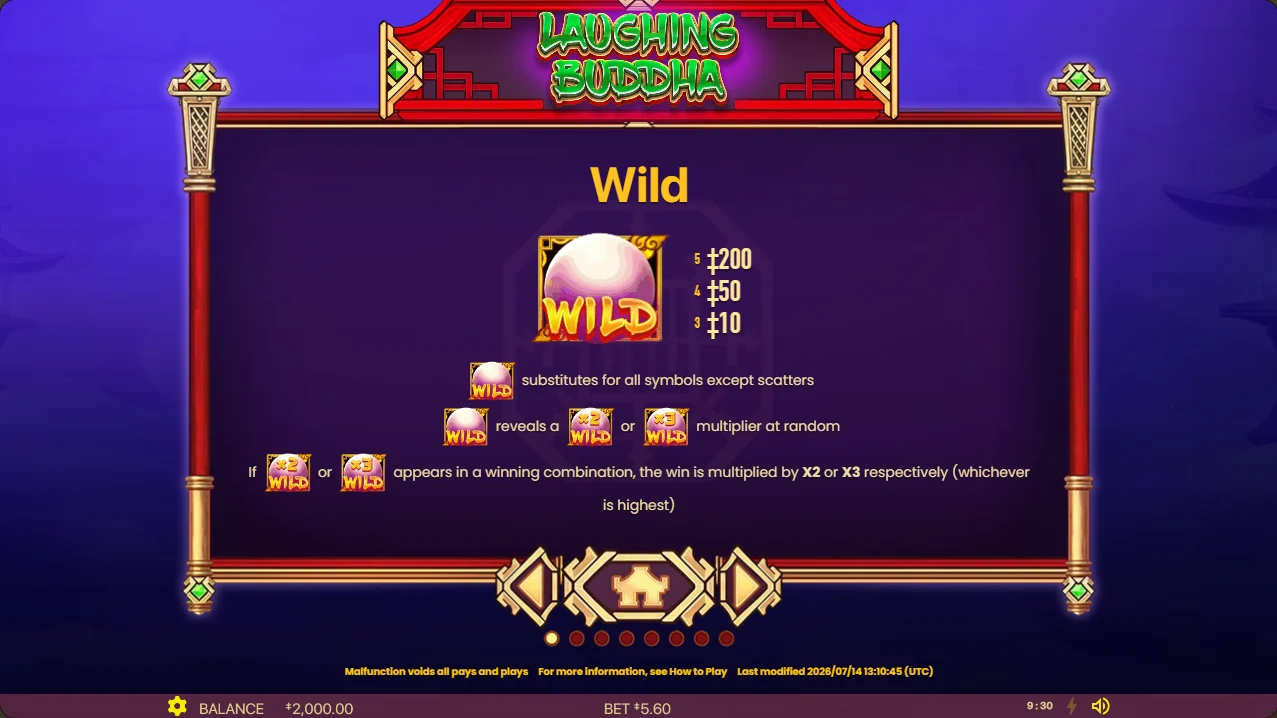
As a simple illustration, take a line that would otherwise return 10. If it qualifies for a 2× Wild multiplier, its return becomes 20. If the applicable highest multiplier is 3×, it becomes 30. This example explains the arithmetic; it is not a claim that we observed those exact amounts in consecutive spins. Different winning lines can produce different awards and are then added to the round total.
Three Scatter pots award eight initial free games. Each pot reveals a possible expanding symbol, and you choose one of the three offered symbols. The selected symbol then expands on its reels before the game awards the pays, leaving Wild and Scatter positions in place. The feature can retrigger with the same selected symbol. Its lines and normal stake remain those of the triggering game.
That choice screen is part of an unfinished paid round. Do not subtract another base stake simply because the interface moves from a trigger to a pick and then through several free spins. Our free-game guide separates the purchase cost, trigger payout and subsequent free-game returns. It also shows the actual choice screen, so you can recognise the point where the client needs your input.
Finish the round and check what happened
A useful record contains the balance before the paid action, its actual cost, the complete returned amount and the final balance. The equation is balance before − cost + return = balance after. For a normal spin, the cost is the displayed total stake. For a purchased bonus, use the full purchase price. For its child free games, do not deduct the original cost again.
Our first base spin reconciled as 2,000 − 5.60 + 12.00 = 2,006.40. After ten fixed-stake base spins, the balance was 1,962.00. Their combined cost was 56.00 and their combined return was 18.00. Those ten observations demonstrate the controls and accounting. They are far too few to measure the game’s long-run RTP or identify a winning staking system.
If the connection drops after a bet, the Help screen says the server can still determine the result. If further input is required, the game resumes from its stored point when reopened. Check the game history before pressing more controls or assuming a refund. The stated policy also has a 15-day limit for an unfinished game. This is the observed client policy, not a promise that every operator handles disputes identically.
For ordinary play, keep the final stake readable, avoid changing it during an unresolved feature and stop autoplay before inspecting controls. Quick Spin changes presentation speed. It does not turn a losing sequence into information about the next result. A compact session record is more useful than an elaborate theory based on how long a reel paused or which side of a button you tapped.
A screenshot of the closing counter is useful, but it is only one part of a complete record. Note whether the counter includes the trigger return, and whether a feature is still waiting for a selection. In our bought feature, the closing total equalled the original trigger return because the eight free games added zero. Without the trigger and continuation record, the same final screenshot could easily be misread as 12.32 earned only during the free spins.
The simplest check for a new player is to write four numbers on one line: before, cost, returned, after. If the equation does not agree, first look for an unfinished animation, an unresolved feature or a different stake denomination. Do not immediately turn a display mismatch into a claim of a missing payment. For an actual account dispute, the operator’s recorded game history and support process are the relevant next step.
Before calling a round finished, check three independent cues. The interface should have returned to ordinary play or its closing feature total. The free-game counter should no longer have games outstanding, and the balance should include the credited result. A spin button becoming visible is not enough on its own: during some presentations, it can act as a skip control. Our recording used the server completion flag as well as the visible screen to separate presentation from settlement.
For a beginner doing this manually, a small fixed-stake notebook is enough. Put each paid ordinary spin on its own row. If it triggers free games, keep those games within the same row and wait before filling the final return column. Put a purchased feature on a separate row with its full price. A count of screenshots, taps or displayed free games is not the same as a count of paid rounds.
Use the stake printed for the actual round when checking an old result. If you raise Coin after a spin and then open the paytable, the newly displayed cash awards reflect the new setting. They are not a retrospective description of the previous bet. The underlying line multipliers remain useful, but you must multiply them by the earlier line stake. Otherwise an entirely correct old payment can look too small.
The same issue arises when switching from normal play to a purchase. Our base examples used a 0.20 coin at level 1, while the bought feature used a 0.02 coin at level 7. A four-K line therefore had a different cash value in those two settings even though the line-award rule was unchanged. Comparing the raw cash amounts without those settings would be a comparison of stakes, not a change in the rules.
The guide separates the decisions into three places to keep this manageable. Use this page to recognise the controls and calculate a line result. Use the free-game guide when a choice or purchase is involved. Use the RTP and mechanics page when you want to understand versions, recorded timing or the server’s completion fields. You do not need those technical details to read an ordinary stake correctly, but they are available when a result needs a closer explanation.
Quick answers
Can I choose fewer than 28 paylines?
No. This client fixes all 28 lines. Reduce the coin denomination or bet level to lower the total stake.
Do two scatters trigger free games?
No. The rules require three gold-pot Scatters. They appear on reels 1, 3 and 5.
Is a 1,000-line-bet payout a 1,000-times-total-stake payout?
No. With 28 equal lines, 1,000 line bets are about 35.71 total stakes before any additional qualifying wins or multipliers.
Does Quick Spin improve the return?
The observed Help screen describes faster presentation, not a different probability or RTP mode.