Two routes into the same eight-game feature
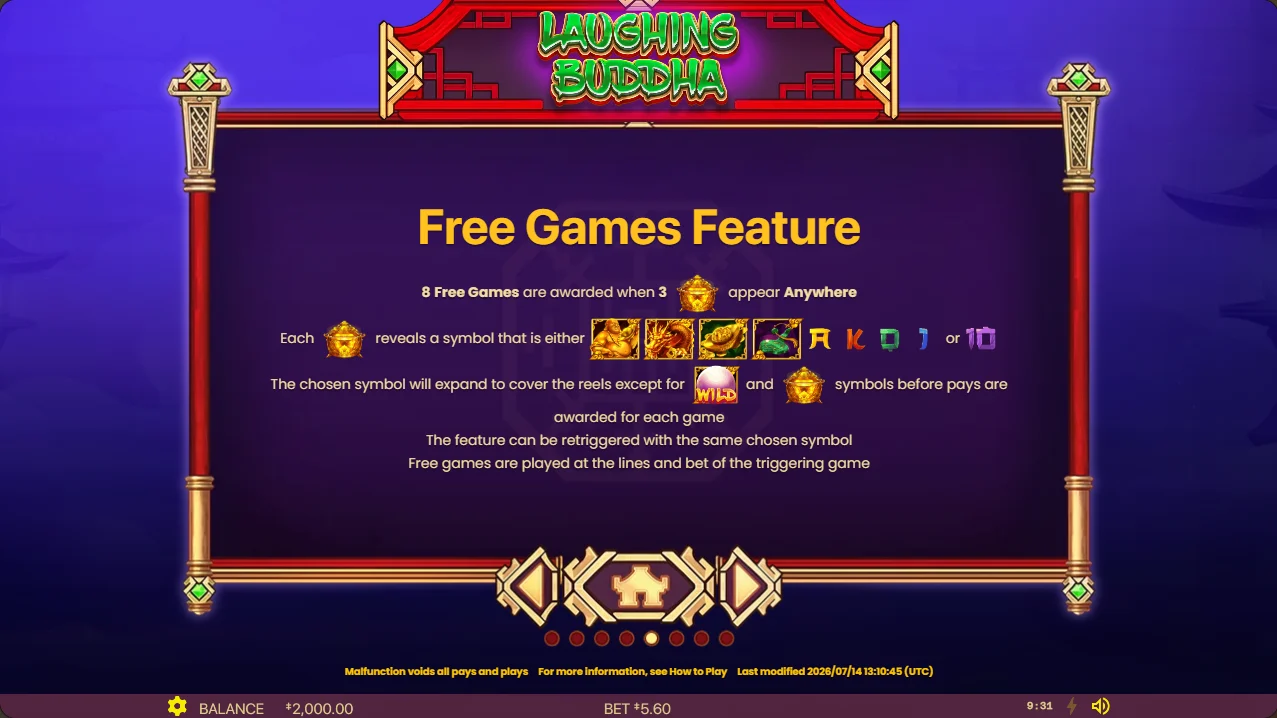
Laughing Buddha offers a natural three-Scatter trigger and a paid Buy Feature route. In normal play, gold pots appear on reels 1, 3 and 5. Landing all three awards eight initial free games. The pots also pay a Scatter award based on the total stake. The feature then asks you to select one of three revealed symbols to expand during the free games.
The Buy Feature route purchases the trigger instead of waiting for it in ordinary spins. It does not buy a particular profit, a particular selected symbol or an unlimited number of free games. The purchase price must be compared with the complete return from that paid round. Any trigger-line wins, Scatter return and free-game returns belong to the same accounting chain.
We observed ten ordinary base spins without a natural feature. We then bought one feature through the visible demo controls and followed it to completion. These are different observations. The purchased example verifies the choice and continuation screens; it does not estimate how often three Scatters land naturally. Ten unsuccessful attempts also cannot establish a natural trigger rate.
The eight free games use the lines and normal stake of the triggering game. They are not eight additional paid spins at the purchase price. If the purchase was 182 and its associated normal stake was 3.92, the free-game awards use that normal stake. The 182 is the one-time cost of entering the feature. Keeping those two figures separate prevents a large error when comparing different sessions.
The price is 1,300 line bets, not 1,300 total bets
The published Buy Feature calculation in the loaded client is 1,300 × coin denomination × bet level. An ordinary spin uses 28 × the same two controls. Divide 1,300 by 28 and the ratio is about 46.43. That is why a 5.60 normal stake produces a 260 purchase price, rather than 5.60 or 7,280.
Examples use one consistent currency or demo unit. If coin value is R0.10, totals are rand; this does not convert the demo’s fun credits into rand. Limits in your actual game still apply.
Swipe sideways to see every column →
| Normal stake | One line | Feature cost | Cost / normal stake |
|---|---|---|---|
| 0.28 | 0.01 | 13.00 | 46.43× |
| 2.80 | 0.10 | 130.00 | 46.43× |
| 3.92 | 0.14 | 182.00 | 46.43× |
| 5.60 | 0.20 | 260.00 | 46.43× |
These examples are arithmetic in a single currency or demo unit. If the actual client offers a R0.10 line stake, the corresponding figures would be R2.80 and R130. Our own recorded purchase used fun-play credits marked with the demo symbol. We have not converted that balance into rand or tested a real-money transaction. Local operator limits can also exclude a mathematically valid combination.
There is a useful budget comparison here. A 182 purchase uses approximately the same cash exposure as 46.43 ordinary spins at 3.92. It does not produce 46.43 spins: it purchases eight initial free games with their feature rules. Comparing the routes only by the number of button presses hides the difference in cost and the distribution of possible returns.
A bonus return of 100 would still be a net loss of 82 after a 182 purchase. A return of 200 would be a net gain of 18. The screen can celebrate both results as wins because both return credits. For your own record, subtract the full purchase price once. Do not subtract it once for each child free game, and do not ignore it simply because the screen switches to a free-game theme.
Why “Bet above 210” blocked our first purchase
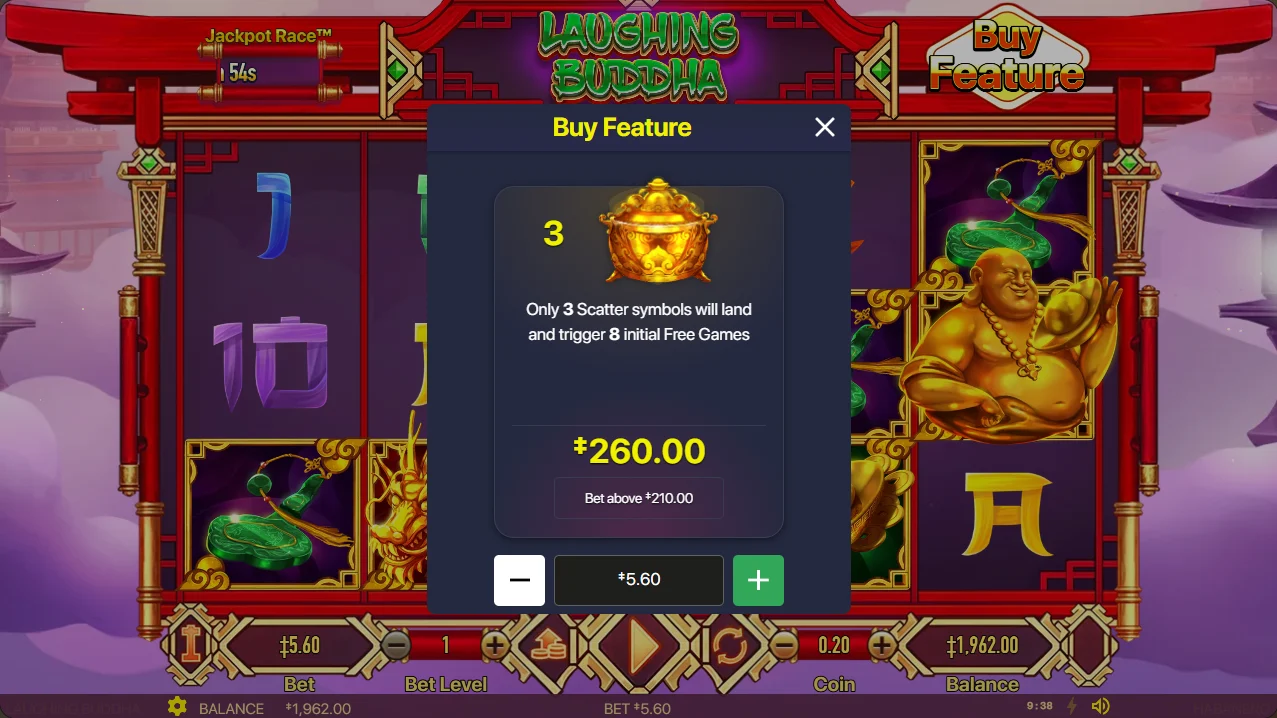
At the default 5.60 stake, the Buy Feature panel showed a price of 260 and a disabled purchase area with the message “Bet above 210.00”. The balance was sufficient, so lack of credits was not the reason. The delivered client compares the purchase price with the applicable maximum and uses this message when the price is too high.
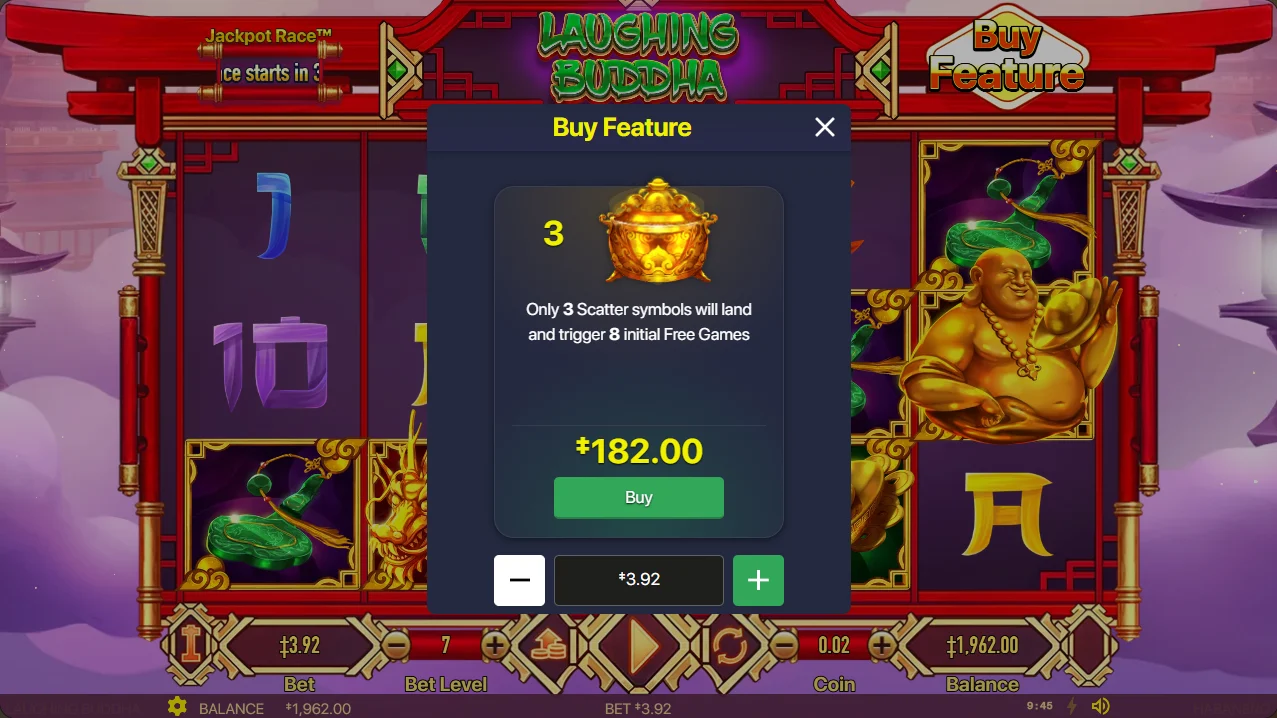
We pressed the ordinary minus control once. The next available normal stake was 3.92, made from coin value 0.02 and level 7. The feature price became 182 and the Buy control became available. Notice that one step did not halve the old 5.60 stake. The interface moves through available total-stake combinations, which is why the final displayed number needs another check.
If you see the same wording, first compare the feature price with the stated limit. Reducing the stake may make the purchase eligible. If it remains disabled, read the current message and balance rather than repeatedly clicking it. A different operator or launch can set a different cap or disable feature buying altogether. No setting on this guide changes the provider’s limits.
The visible minus control brought the purchase within the limit. It also stops a common budgeting mistake: treating the normal stake at the bottom of the panel as the price that will leave the balance when Buy is pressed.
Which expanding symbol should you choose?
Our purchased trigger revealed J, Buddha and K. We selected the middle Buddha symbol. The picture below shows the choice before we clicked it. The selected symbol determines which matching symbols expand on their reels. Wilds and Scatters keep their positions rather than being overwritten by the chosen symbol.
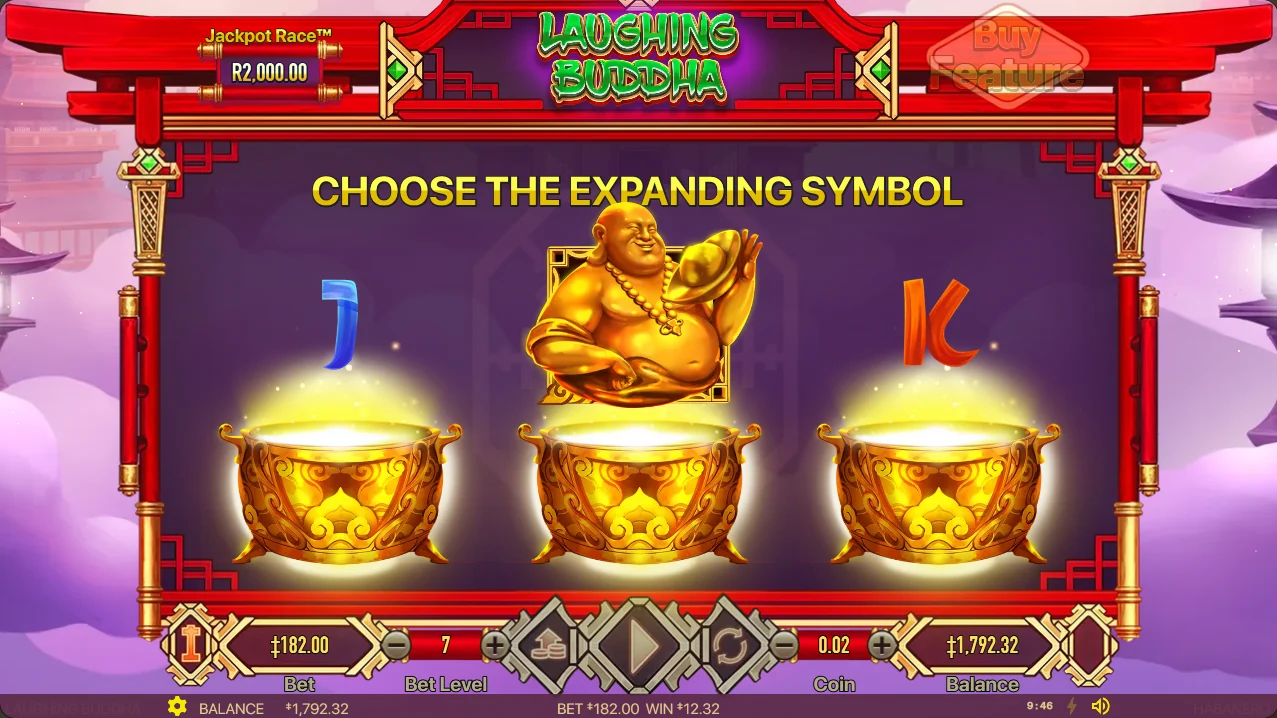
The Buddha is the highest-paying ordinary symbol on the displayed paytable. That fact alone does not establish it as the best pick. Expected return depends on how often relevant symbols and Wilds appear, how they occupy the paylines and how the feature is configured. The paytable lists awards, not all those probabilities. A rarer high award can have the same or a lower expectation than a more frequent small award.
The Help screen says player strategy cannot affect the stated RTP unless otherwise specified. We found no instruction in this build promising a higher RTP for a named symbol choice. We therefore do not label Buddha, J or K as a verified profitable selection. The honest answer is that we can show what the choice does, while the evidence is insufficient to rank the three options by expected profit.
If you want to compare choices experimentally, choose the comparison rule before collecting a new sample and keep the normal stake, RTP version and feature-entry method consistent. Do not compare one bought Buddha bonus with a natural J bonus at a different stake and call the larger money amount the winner. A useful comparison would also include every low return, not only screenshots of expanding reels.
You do not choose a new symbol on every free spin. The chosen symbol remains part of that feature, including a retrigger according to the rules. The visible shape of a reel after expansion can look generous while no valid left-to-right line connects across enough reels. Expansion creates opportunities within the payline system; it does not make every full reel a separate paying win.
The choices are revealed before the player selects one. In our recorded request flow, the trigger supplied three selectable symbol identifiers, and the following pick action selected the middle offered option. The symbols were therefore not merely decorative labels added after the free games had already been shown. We did not establish how the unseen probability model differs between those options. The existence of a real choice does not settle that question.
Follow one purchased feature all the way to settlement
Before our purchase, the demo balance was 1,962.00. The purchase cost 182.00. Its trigger returned 12.32, consisting of 8.40 in line wins and 3.92 from the three Scatters. The balance therefore reached 1,792.32 before the eight free games had finished. Reading that intermediate credit as the finished bonus would have been premature.
Swipe sideways to see every column →
| Stage | New cost | New return | Balance |
|---|---|---|---|
| Before purchase | — | — | 1,962.00 |
| Purchased trigger | 182.00 | 12.32 | 1,792.32 |
| Symbol selection | 0.00 | 0.00 | 1,792.32 |
| All 8 free games | 0.00 | 0.00 | 1,792.32 |
| Complete purchased round | 182.00 | 12.32 | 1,792.32 |
Complete-round net result: −169.68 demo units, after subtracting the full 182.00 purchase price.
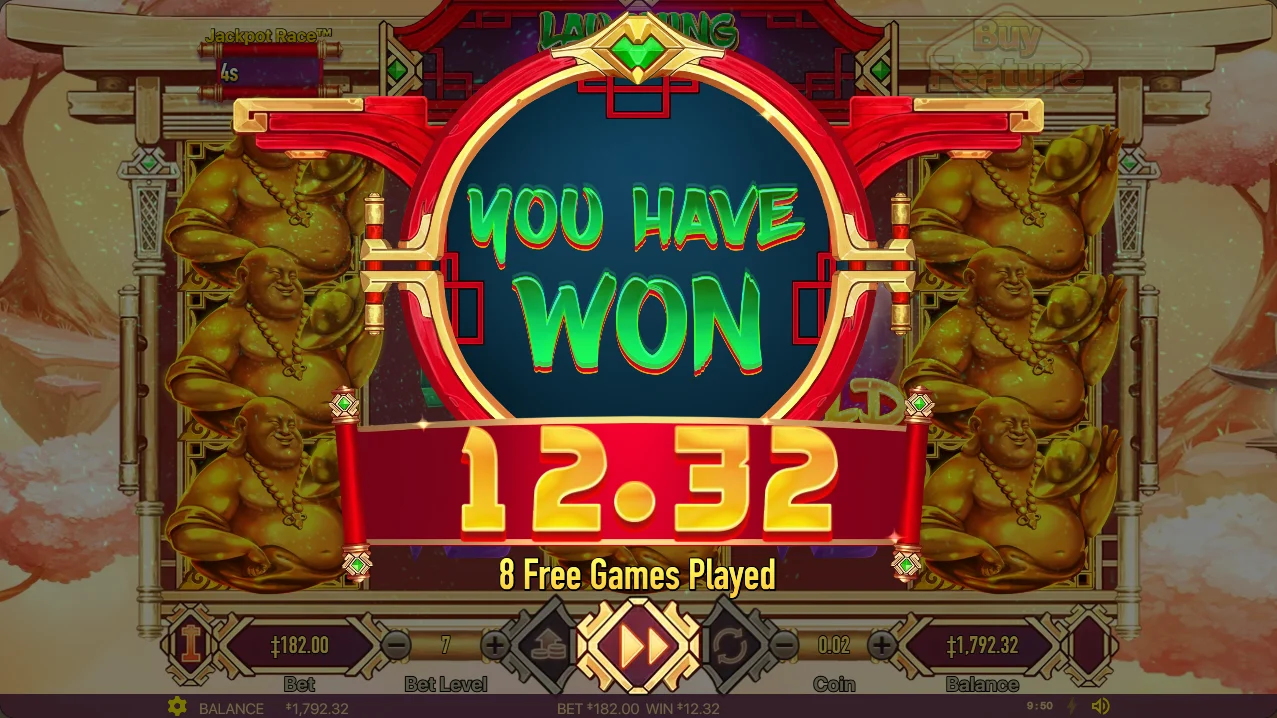
The final balance reconciles exactly: 1,962.00 − 182.00 + 12.32 = 1,792.32. The eight free games did not incur another paid debit. No retrigger occurred in this example. We recorded one purchase, one symbol-pick action and eight child free-game responses. Those ten game messages are one purchased paid round, not ten purchased bonuses.
This is a deliberately complete example rather than a highlight reel. It proves that a fully functioning bonus can return less than its price, even when an expanding Buddha covers visible reels. It does not prove the feature always loses, that Buddha is the worst pick or that a different choice would have won on this same sequence. We did not play the counterfactual choices and cannot know their results from this session.
The normal and purchased samples remain separate throughout the site. Combining the 56-unit cost of ten ordinary spins with the 182-unit purchase would make a single return percentage, but it would conceal two distinct entry routes. For deciding what you are about to buy, the individual cost and completion chain are more informative than an impressive-looking combined sample count.
The first purchase response already contained both ordinary line wins and the Scatter award. A separate symbol-pick exchange followed, then eight free-game exchanges. At each step we checked the supplied balance against the previous balance plus the new return. The final response marked the game complete and returned the state to main play. This matters because an incomplete bonus can make a temporary balance look like a finished result.
The recorded return of 12.32 included a 3.92 Scatter payout, which matched the underlying normal stake. The other 8.40 came from four line wins of 2.10. Each of those wins used a 3× multiplier on a low-symbol line award. The feature-entry price remained 182.00. Those three different values—line award, normal stake and purchase price—explain the result more clearly than treating every displayed number as another bet.
Read these details before another bonus
First, establish which RTP version the current client is using. Our demo stated 96.64% for normal play and 96.57% for the three-Scatter purchase. Those are long-run mathematical figures, not the return from our one feature. The provider offers other variants. A headline percentage on a guide is not a substitute for the Help screen in the version you actually open.
Next, check the full purchase price and your remaining budget. A feature button can make a large transaction feel like one ordinary click. If your chosen spending limit is smaller than the purchase, lowering the stake or staying in the free demo are available decisions. A previous loss does not make the next purchased feature cheaper or more likely to recover it.
Finally, let the feature finish. The choice prompt, free-game counter, retrigger and closing total all belong to the same paid round. If a connection issue interrupts the sequence, return to the game or its history rather than assume the partial counter is final. Save the purchase amount and final balance when reporting a discrepancy to the operator that holds the account.
A retrigger would extend the feature while retaining its selected symbol, according to the rules. It would not create a new separately purchased bonus. If you compare two histories, record both the initial eight games and any additional games actually awarded. A feature with more games may return more cash without proving that its chosen symbol or entry method has a superior expectation. We did not observe a retrigger in this session.
A simple final check is to compare the closing total with the trigger return that was already credited. If the two are equal, the child free games may have added nothing, as in our recorded example. If the closing total is larger, only the difference is the additional feature return. Keep that distinction when describing a screenshot: “twelve units from eight free games” would misdescribe our result because the twelve units came from the trigger.
Quick answers
How many free games do three Scatters award?
Eight initially. The rules allow a retrigger with the same selected symbol, but our single purchased example did not retrigger.
Is Buy Feature exactly 46 times the stake?
The exact ratio in this client is 1,300 ÷ 28, approximately 46.4286 times the normal total stake. Read the displayed money price before buying.
Did our Buddha choice make a profit?
No. The purchased round cost 182 demo units and returned 12.32, a net loss of 169.68. One observation cannot rank the available symbol choices.
Why can the final win equal the trigger return?
The total includes the trigger. In our observation the subsequent eight free games added no further return, so the closing total remained 12.32.